


Australia’s Wild Brumby Fights for Survival in Barmah Forest
Their home was flooded. Their food supply washed away. And those with the power to make things right simply sat back and watched as tragedy engulfed the forest.
NO MATTER WHAT YOUR EQUINE passion or discipline, listening to a mare as she screams out to her panicked foal because she’s weak and unable to get up is a sound you will never forget. Seeing her bloodied, emaciated and battered body– caused by attempts to get up – is an image you will never forget. This is the reality endured by the Brumbies who call the Barmah Forest along the Murray River in Victoria their home.
A long time ago, in the late 1700s, European settlers arrived in Australia with horses imported from England. Capers from South Africa, ponies from Great Britain and Indonesia, Arabians, Draft horses, and Thoroughbreds were among those that made the grueling voyage by boat; and they all played an integral role, allowing settlers to explore and work the land.
It is believed that when they were no longer needed, many were released by their owners, set free to conquer the Australian bush on their own. Thus, they became as wild as the land and made it their home.
Descendants of those horses are known as Brumbies and can be found throughout Australia, typically in the Northern Territory, Queensland, New South Wales, Victoria, and in the country’s western and south-ern regions. They travel in mobs or bands and vary in height and colour with heavy heads, straight shoulders, short necks and backs.

Brumbies are wild horses like American Mustangs. They are heritage horses that helped colonize Australia and carried soldiers to war. Today, they keep communities alive financially by attracting tourist dollars to country towns that would otherwise struggle. But in a country where a horse race – the Melbourne Cup – stops the nation, Brumbies are viewed as “feral pests” by the government, which seeks to eradicate them from a landscape they have been a part of for hundreds of years.
For the most part, the Barmah Brumby live out their lives unaffected by government or human interference and are known to self-regulate, keeping their population between 150-300. Though Parks Victoria struggled to count more than 100 on 77,000 acres of land, plans are now in place to eradicate them.
Neglect falls into three categories: unintentional neglect (due to ignorance), intentional neglect (knowledge of situation but unable to provide care due to lack of finances), and intentional cruelty (deliberately starving, withholding care etc.).
Water regulators MDBA (Murray Darling Basin Authority) are responsible for sending water down the Murray River through lochs and weirs to provide farmers with irrigation water, as well as provide ‘environmental water’ to offset the detrimental effects on the ecosystems along the lower reaches of the river. This ‘environmental flooding,’ however, is being done at incorrect times, durations and depths, which is having significant negative effects on the forest wetland, ecology and animals within the park.
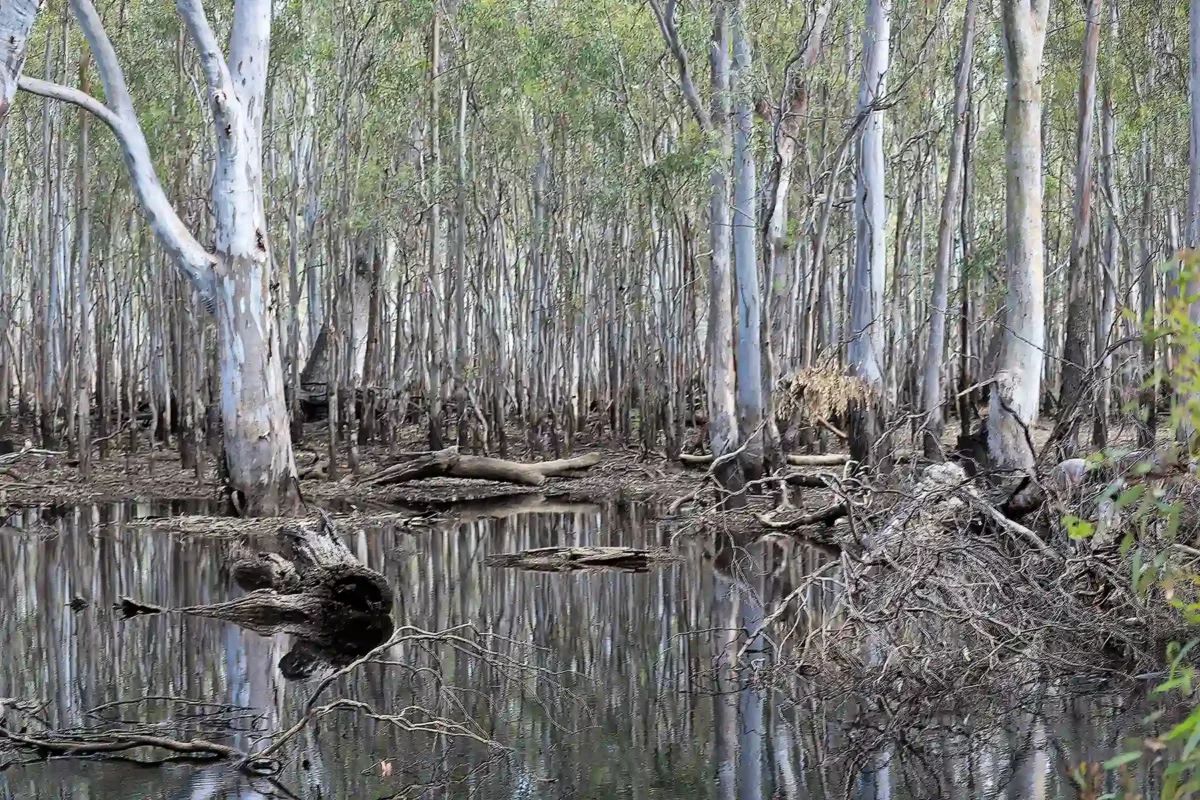
In 2018, MDBA made unprecedented changes to the natural flooding patterns of the Barmah Forest, compromising approximately 90% of the habitat. The flooding forced Brumbies, kangaroos, emus, wallabies, and other wildlife onto land with limited resources. The toll was catastrophic. With hundreds of animals competing for food, starvation set in and the forest quickly became a cemetery of decaying carcasses. The worst affected were the brumbies, left to starve over many months. This raised an important question: if private individuals who leave horses to starve on their property are charged, why is the government not being held responsible for inflicting intention-al cruelty on the Barmah Brumbies?
Marilyn Nuske, an animal rights lawyer, explains the complexity of legislation and why the Prevention of Cruelty to Animals Act could not or would not be used: “Management takes place within the context of the key state and commonwealth legislations and the powers bestowed upon Parks Victoria within a legislative regime that has given to Parks Victoria the power to basically do whatever they believe to be necessary to ‘protect natural and cultural values’. The legislative power allows Parks Victoria to declare the brumbies, an introduced species, as “feral pests” to lobby for their removal and/or destruction as ‘feral pests’ regardless of any grounds that brumbies feature strongly in Australia’s history and development of culture.
“RSPCA Victoria is a non-government, community-based charity that ‘works to pre-vent cruelty to animals by actively promoting their care and protection’ but does not engage proactively in the protection of the Barmah Brumbies. It is believed the RSPCA collabo-rated with Parks Victoria and even accompanied officers on their rounds in the Barmah Forest along with Parks Victoria vets. When the RSPCA declined to intervene, Parks Victoria knowingly allowed brumbies to be left without food, causing many to starve to death.”
And that’s when volunteers stepped in to do what Parks Victoria said couldn’t be done – feed the Brumby. Funds were raised to feed over $2,500 (AUS$) of hay each week as volunteers risked severe fines to keep approximately 120+ horses alive over a period of 6 months. During this time, the RSPCA stood by passively and advised Parks Victoria that any horse with a body score of 1.5 or below be euthanized, by gun shot. They later rescinded their recommendation as public pressure grew. They never advised that feeding should have been the alternative.
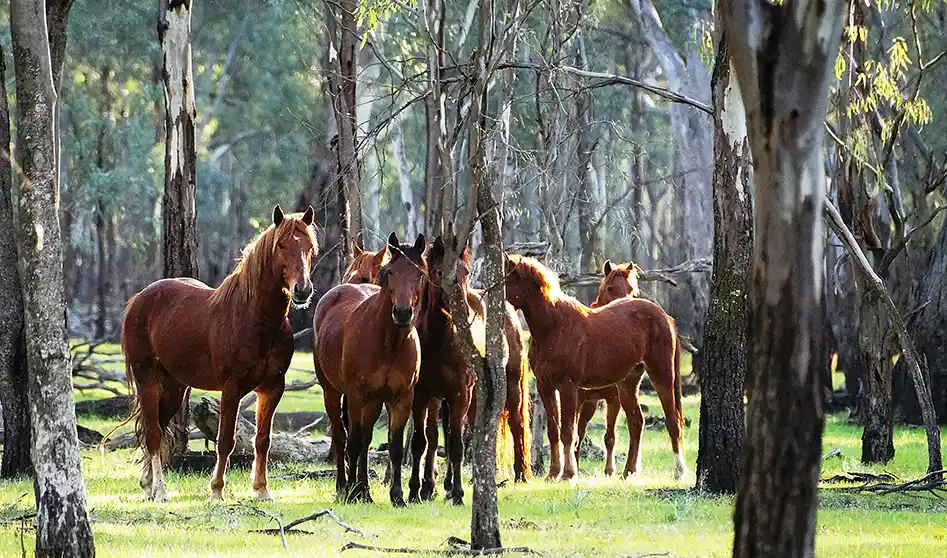
What transpired in the Barmah Forest was preventable, that’s what made it such a tragedy. Intentional human interference with the environment caused the Brumby – and many other wild animals – to suffer a slow, painful death while those in power sat back and did nothing to right the wrongs. Perhaps what occurred was the plan all along: a cull of ‘invasive species’ by means of excessive flooding. We will never know. What we do know is that horse welfare standards, as they currently stand, lack the support and confidence of the equine community. It is time to fix that.
Many thanks to Gerry and Kaye Moor, who were the force behind the feeding regime, and the countless other volunteers that kept efforts going. To learn more about the Australian Brumby and how you can help, visit hoofs2010incorporated.com or Barmah Brumby Hay Angels (on Facebook).
This story originally appeared in the Fall 2019 issue of Thoroughbred Today Magazine.
Written by Renee Neubauer, with photography by Lynette Sutton.
 About
About Subscribe
 Contact
SHOP OUR MARKETPLACE
Vegan Leather Horse Keychain
Delaire Backpack
Square Braided Split Reins
Christmas Poinsettia Wood Horse Head Wall Decor – Gift Christmas Wreath – Custom Colors Available – Multi-Media Equestrian Art
VIEW ALL PRODUCTS >